

VCE to NCAA GPA Conversion: A Step-by-Step Guide for Victorian Student-Athletes
How to convert your VCE study scores and ATAR into an NCAA GPA. Includes a study-score-to-letter-grade table, the 16 core course rules, the 10/7 trap and worked examples for Victorian students.
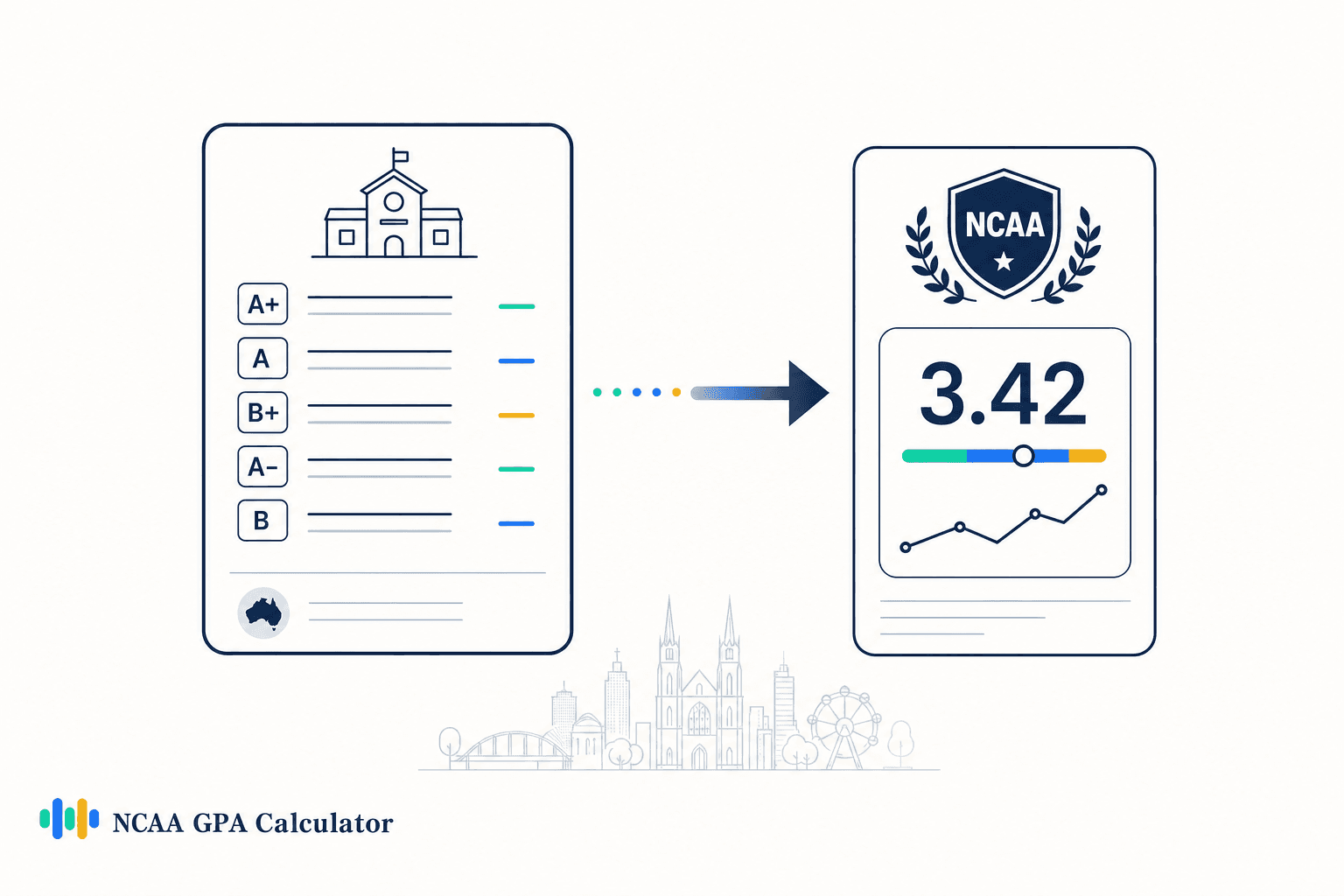
If you finished Year 12 in Victoria and you're hoping to play college sport in the United States, the first thing US coaches and the NCAA Eligibility Center will look at is your NCAA core GPA. Not your ATAR, not your study scores, not your VCE certificate. They want to see your VCE grades translated onto a 4.0 scale, with only the right subjects counted.
This guide walks you through exactly how that translation works for VCE, where Victorian students typically lose points, and what your real eligibility picture looks like.
Just looking for the eligibility process end-to-end? This post is the grade-conversion deep-dive. For the full Victorian eligibility walkthrough (acceptable graduation certificates, approved subjects, year-by-year action plan), read the VCE, VCAL and VM to NCAA Eligibility Guide.
Still picking subjects? Use our free interactive VCE Subject Planner - built with Basketball Victoria. Add subjects you've taken or are planning across Year 9-12 and it shows you in real time which count toward NCAA core, which to avoid, and what's missing from your D1/D2 plan.
Your NCAA core GPA is the unweighted average of your core course grades on a 4.0 scale. It is not your ATAR, not your aggregate, and not an average of all your VCE study scores. The selection of subjects matters as much as the grades themselves.
Why the ATAR doesn't help you here
The ATAR is a percentile rank. It tells US colleges that you finished in the top X% of Victorian students, but it doesn't translate to a GPA on the 4.0 scale that the NCAA Eligibility Center uses. The NCAA needs individual subject grades, year by year, mapped to American letter grades.
That means the inputs to your NCAA GPA are your VCE study scores (the 0–50 number reported per Unit 3/4 subject) and, where applicable, your Unit 1/2 results from Year 11. The ATAR itself is essentially irrelevant to NCAA eligibility, although some US colleges may still ask for it as a general academic indicator.
Step 1: Identify your NCAA core courses
The NCAA only counts grades from core academic courses. For a VCE student, that means looking through your subject list and separating the academic subjects from the rest.
Subjects that typically count as core ✅
- English: English, English Language, Literature, EAL
- Maths: General Mathematics (Further), Mathematical Methods, Specialist Mathematics
- Science: Biology, Chemistry, Physics, Psychology, Environmental Science
- Social science: History (any unit), Geography, Economics, Legal Studies, Politics, Philosophy, Sociology, Global Politics
- Additional academic: LOTE subjects (French, Japanese, Chinese, Italian, etc.), Classical Studies, Religion and Society
Subjects that typically don't count ❌
- Physical Education, Health and Human Development, Outdoor and Environmental Studies
- Studio Arts, Visual Communication Design, Media, Drama, Theatre Studies, Music Performance
- Product Design and Technology, Food Studies, Systems Engineering
- Business Management (grey area; sometimes accepted as additional academic)
- VCE VET subjects, VCAL units, Industry and Enterprise
The NCAA requires maths at Algebra 1 level or higher. Foundation Mathematics and some pathways within General Mathematics may not meet that bar. If your only VCE maths sequence was Foundation, you'll likely need to add a higher-level maths course before you can be cleared.
Step 2: Convert your VCE grades to the 4.0 scale
The NCAA's Guide to International Academic Standards publishes a conversion table for VCE, and importantly, it's based on the letter grades reported on your VCE Statement of Results (per assessment), not on your Study Score.
VCE letter grade → NCAA letter grade (per the NCAA International Guide)
| VCE Grade | NCAA Letter | Grade Points |
|---|---|---|
| A | A | 4.0 |
| B | B | 3.0 |
| C | B | 3.0 |
| D | C | 2.0 |
| E | D | 1.0 |
| F, G or H | F | 0.0 |
| UG | F | 0.0 |
Notice that a VCE C grade still maps to a US B (3.0), and an E maps to a D (1.0), not an F. The NCAA's conversion is meaningfully kinder than a one-for-one letter swap. This is the opposite of how most online guides describe it.
VCE Unit 3/4 study scores → NCAA letter grades (approximate)
The NCAA officially evaluates the per-assessment letter grades on your Statement of Results, not your Study Score. But because most students think in Study Scores, here's the rough mapping you can use as a sanity check:
| VCE Study Score | Approx. Percentile | NCAA Letter | Grade Points |
|---|---|---|---|
| 40 – 50 | Top 9% | A | 4.0 |
| 33 – 39 | Top 30% | B | 3.0 |
| 25 – 32 | ~Median | C (maps up to B – see above) | 3.0 |
| 20 – 24 | Below median | D (maps to C) | 2.0 |
| Below 20 | Bottom band | E or below | 1.0 or 0.0 |
The Eligibility Center reviews Australian transcripts on a case-by-case basis using the NCAA International Guide as the framework. The numbers above are the published table. The final certified GPA depends on which subjects the evaluator accepts as core, the per-assessment grades on your Statement of Results, and the proof-of-graduation documents you submit. We use the published table as our starting point and flag any judgement calls in your report.
The NCAA core GPA is unweighted. That means a Specialist Mathematics A counts the same as an English A. Victoria's scaling system, which boosts harder subjects in the ATAR calculation, has no equivalent inside the NCAA model. If you want to maximise your NCAA GPA, you maximise the number of A's, not the difficulty of the subjects.
Skip the manual conversion
Upload your VCE statement of results and we'll build the full NCAA core GPA picture for you, including which subjects qualify and which don't.
14-day money-back guarantee. Read your report. If it isn't the clearest picture of your NCAA eligibility you've had, get a full refund within 14 days. No questions asked, and you keep the report. Details
Step 3: Apply the 16-course requirement
For NCAA Division I and II eligibility you need 16 core courses completed across high school. For a Victorian student, "high school" maps to Years 9 through 12.
| Category | Required |
|---|---|
| English | 4 years |
| Mathematics (Algebra 1 or higher) | 3 years |
| Natural / Physical Science | 2 years (1 must be a lab science) |
| Additional English, Maths or Science | 1 year |
| Social Science | 2 years |
| Additional core (any of the above + LOTE) | 4 years |
| Total | 16 courses |
A "year" here generally means a year-long subject. A semester-only subject counts as a half-credit, so two semester-length subjects in the same area equal one core course year.
Step 4: Watch out for the 10/7 rule (Division I only)
This is the rule that catches more Australian students than any other piece of NCAA fine print:
- 10 of your 16 core courses must be locked in before Year 12, and
- 7 of those 10 must be in English, maths or science.
In Victorian terms, that means by the end of Year 11 you should already have ten core subjects on the books (typically 4 from Year 9, 4 from Year 10, and your two Unit 1/2 sequences from Year 11), and at least seven of them have to be English, a maths, or a science. Year 12 is treated as a "lock-in" year, not a make-up year.
A student picks PE, Studio Arts and Outdoor Ed in Years 9 and 10 because they're "easy" or aligned to sport. By the time they reach Year 12, they've burned through too many non-core slots and physically can't fit 10 core courses before their final year. Plan core subjects from Year 9.
Division II has the same 16-course requirement but no 10/7 rule, so late-blooming students often end up qualifying for D2 even when D1 is closed off.
Step 5: Calculate your NCAA core GPA: a worked example
Let's run a realistic VCE student through the process.
Subjects and results (Years 11 and 12):
| Year | Subject | Result | Core? | NCAA Grade |
|---|---|---|---|---|
| 11 | English Units 1/2 | B | ✅ | B (3.0) |
| 11 | Mathematical Methods 1/2 | A | ✅ | A (4.0) |
| 11 | Biology 1/2 | B | ✅ | B (3.0) |
| 11 | History 1/2 | A | ✅ | A (4.0) |
| 12 | English Units 3/4 | 35 | ✅ | B (3.0) |
| 12 | Mathematical Methods 3/4 | 41 | ✅ | A (4.0) |
| 12 | Specialist Maths 3/4 | 33 | ✅ | B (3.0) |
| 12 | Biology 3/4 | 38 | ✅ | B (3.0) |
| 12 | Physical Education 3/4 | 42 | ❌ | not counted |
For the NCAA core GPA, we add up only the core grade points and divide by the number of core subjects:
Core grade points: 3.0 + 4.0 + 3.0 + 4.0 + 3.0 + 4.0 + 3.0 + 3.0 = 27.0
Core subjects: 8
NCAA Core GPA = 27.0 ÷ 8 = 3.375
That 42 in PE (a fantastic result that scaled beautifully into the ATAR) does nothing for the NCAA. This is the single biggest mental shift Victorian students need to make.
Where Victorian students typically land
| ATAR Range | Likely NCAA Core GPA Range | D1 Eligibility |
|---|---|---|
| 95+ | 3.7 – 4.0 | Well clear of the D1 minimum |
| 85 – 95 | 3.2 – 3.7 | Comfortably eligible |
| 70 – 85 | 2.6 – 3.2 | Eligible. Academic admissions become the gating factor |
| 50 – 70 | 2.3 – 2.8 | Tight. D2 / NAIA more realistic |
| Below 50 | Below 2.3 | NAIA pathway most likely |
These are typical outcomes. The actual mapping always depends on which subjects you took. A 75 ATAR built on academic subjects can easily produce a higher NCAA GPA than an 85 ATAR built on non-core electives.
The NCAA sliding scale (Division I): only if you submit test scores
NCAA Divisions I and II permanently removed the standardized test (SAT/ACT) requirement for initial eligibility, effective for student athletes enrolling on or after 1 August 2023. If you don't submit test scores, your NCAA initial eligibility is determined by your core GPA alone (minimum 2.3 for D1, 2.2 for D2).
If you choose to submit SAT or ACT scores (for example, because the US universities you're applying to still require them for general admission), the sliding scale below comes back into play, with a higher GPA letting you "make up" for a lower test score:
| Core GPA | SAT (EBRW + Math) if submitting | ACT Sum if submitting |
|---|---|---|
| 2.3 | 980 | 75 |
| 2.5 | 900 | 68 |
| 2.7 | 820 | 59 |
| 3.0 | 720 | 50 |
| 3.5 | 400 | 37 |
For NCAA initial eligibility purposes, the SAT/ACT is optional. However, many US universities (especially academically-selective programs) still require the SAT or ACT for general admission to the university itself, so check with each school you're applying to before deciding whether to skip it.
Victorian students who took an academic VCE program (English, a maths, a science and a humanities) generally end up in the 3.0 to 3.5 NCAA GPA range, comfortably above the 2.3 D1 minimum.
Common Victorian-specific mistakes
- Counting the ATAR. The ATAR isn't your NCAA GPA. Telling a US coach "I got 87" doesn't communicate anything about your NCAA eligibility.
- Including Unit 3/4 PE in the GPA calculation. It's an academic course in the VCE sense but the NCAA doesn't recognise it as a core subject.
- Forgetting Year 11 grades count. Many students assume only Year 12 matters because that's what feeds the ATAR. The NCAA wants all four years of high school.
- Choosing "easy" non-core subjects. A Year 10 timetable stacked with Outdoor Ed, Drama and Studio Arts looks fine for the ATAR but blows up your 10/7 numbers.
- Submitting the VCE Statement of Results without context. International transcripts often confuse evaluators. A clean, annotated transcript pack converts faster.
What to do next
If you're at the start of VCE: lock in 4 core subjects every year from Year 9 onward, with English, a maths and a science always present. That single rule keeps every NCAA pathway open.
If you've already finished VCE: pull your Statement of Results, your Year 11 reports and your Year 9–10 transcripts, and run them through an actual NCAA conversion. The numbers are usually better (or worse) than students expect, and the only way to know is to do it properly.
Get your VCE-to-NCAA conversion done properly
We'll convert your VCE grades, classify each subject as core or non-core under NCAA rules, run the 10/7 check, and tell you exactly where you stand for D1, D2 and NAIA.
14-day money-back guarantee. Read your report. If it isn't the clearest picture of your NCAA eligibility you've had, get a full refund within 14 days. No questions asked, and you keep the report. Details
Free tool · Built with Basketball Victoria
Try the VCE Subject Planner
Pick the subjects you've taken and the ones you're planning — it shows you which count toward NCAA core, which are blocked, and what to take next. No login, saves automatically.
Open the plannerOther Australian state guides
Studying in a different state? Each Australian state has its own NCAA grading scale and approved-course list. Pick yours:
Keep reading
VCE, VCAL and VM to NCAA: The Complete Eligibility Guide for Victorian Student-Athletes
13 May 2026 · 10 min read
NCAA Swimming Eligibility for Victoria Athletes: VCE GPA & Recruiting Guide
12 July 2026 · 7 min read
NCAA Golf Eligibility for Victoria Athletes: VCE GPA & Recruiting Guide
7 July 2026 · 7 min read